
A flat possession snagging checklist works room by room: one wide photo, then a close photo with a scale for every defect, each tied to a short note and a date. Do this before you sign the possession letter, not after. This post is for flat buyers, their inspectors and builders' handover teams. It covers the photo standard, what to write on site, what photos cannot show, and a final checklist.
The walk-through nobody could prove
A buyer walks through a new flat with the builder's handover executive. There is a hairline crack above the bedroom window, a tile that sounds hollow, and a bathroom door that does not close. The executive says it will be fixed before possession.
Three weeks later the buyer signs, moves in and writes to the builder. The reply asks for proof that these defects existed at handover. The buyer has a few phone photos in a chat, with no dates anyone can trust and no way to say which room each one shows.
Nobody lied. Nobody could prove it either. A snagging record fixes that: the same photos, taken in a fixed order, with the date and a note attached to each.
Why unrecorded snags cost money and time
A snag is a defect or unfinished item found at handover: a crack, a leaking tap, a misaligned shutter, a missing switch plate. Handover is the point where both sides agree what condition the flat is in.
When the record is thin, three things happen:
- Argument over timing: the builder says the damage came after you moved in. You say it was there on day one.
- Repeat visits: without a numbered list, the same items are looked at again and again.
- Money spent first: buyers pay a plumber or painter themselves, then try to recover the cost.
On defect liability, the RERA Act 2016 deals with it in section 14(3). As commonly read, a structural defect or a defect in workmanship, quality or services brought to the promoter's notice within five years of possession must be made good. The exact period, what counts as a defect and the complaint process are for your lawyer or your state RERA to confirm. A dated record of what you saw at handover helps whichever route you take.
With a dated snag record and without
| Without a record | With a dated snag record | |
|---|---|---|
| Photos | Scattered in a gallery and chats | One numbered set, taken in order |
| Date | Phone clock, easy to doubt | Stamped on each photo at capture |
| Which room | Memory | Room named in the note |
| Builder's team | Asks you to show again | Gets the list the same day |
| Your position | "You said so" | "Here is what was there at handover" |
A record does not make a builder agree. It makes the conversation shorter, because both sides are looking at the same list. For why chat photos are weak evidence, see how a photo's date and time can be changed.
The photo standard: room by room
Take a torch, a tape or a steel scale, a pencil and masking tape. Walk in the same order every time: entrance, living room, kitchen, each bedroom, each bathroom, balcony, utility.
Every room: the opening shot
Stand at the door and take one wide photo of the whole room. This shows which room the close-ups belong to. Add a photo of the ceiling and one of the floor.
Walls and ceilings
Photograph cracks with a scale beside them, once close and once from a step back. Use the torch held low and sideways to show uneven plaster or paint patches. Mark the end of a crack with a pencil line so a later photo shows whether it grew.
Floors and tiles
Tap tiles with a coin or knuckle and mark hollow ones with masking tape. Photograph the tape, then the tile joint. Show gaps, lippage and chipped edges with a scale.
Doors and windows
Photograph each door closed, then open, and the gap at the latch side. For windows, show the frame, the glass, the track and the lock. Show any paint or cement stains on glass.
Kitchen and bathrooms
Take photos of the slope towards the drain, the counter joints, the taps and each fitting. Run water and photograph any drip or pooling. Photograph the geyser point, the exhaust fan and the ceiling below any wet area.
Electrical
Photograph each switchboard with the plates on, and the meter and DB (distribution board) box. Note any switch that does not work. Do not open live panels.
Balcony, terrace-facing walls and the meter
Show the railing, the floor slope and the outer wall edge. Photograph the water and electricity meter readings, since they set your starting point.
How to do it with Verafii
Verafii is a camera and report app. It suits an inspector or a builder's handover team that walks many flats. A single buyer can use any camera with a clear date, but the steps below show what the app does.
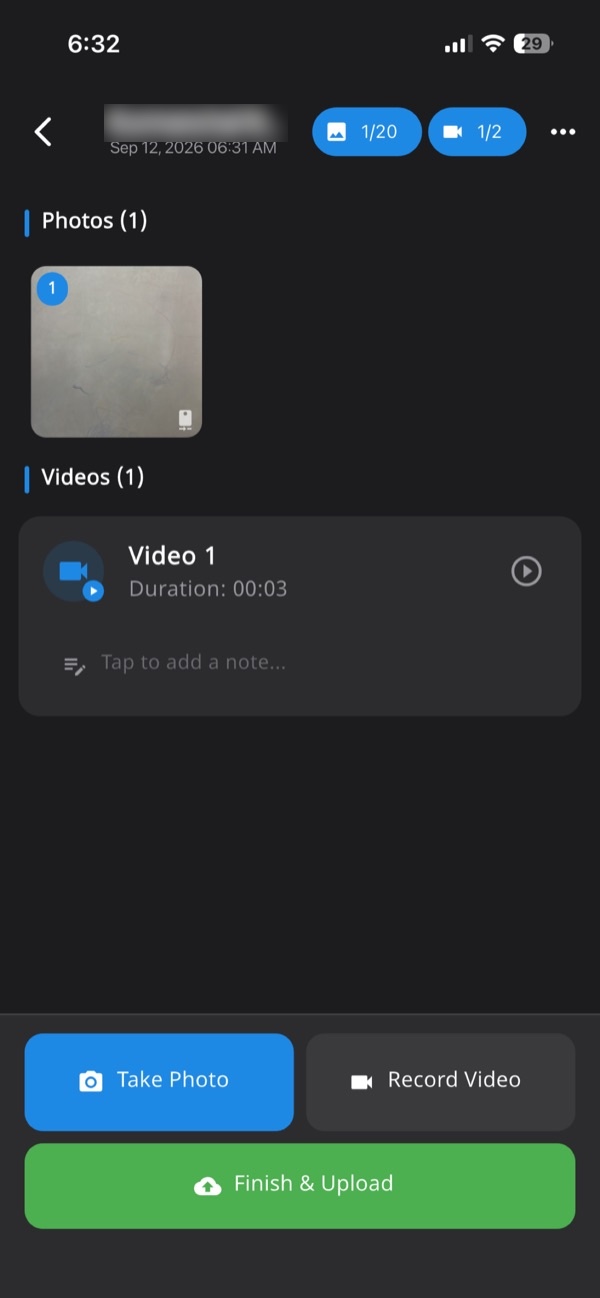
- Open Verafii and start a new job for the flat, named by tower and flat number.
- Take each photo with Verafii's own camera. There is no gallery and no file picker, so every photo is taken live in the flat.
- Add a short note to each photo: room, location and what is wrong.
- Keep going room by room. Every photo, video and note lands in one numbered session tied to the site.
- Record a short video with audio for anything that moves, such as a door that scrapes or a tap that drips.
- Before you leave, make the one-tap PDF report. It carries the location, device, time and a QR code.
- Share the PDF with the builder's team and keep a copy.
Each photo has GPS and time burned in at the shutter. Anyone can scan the QR to open the public check page, with no account and no app.
If you are a builder's team and want the buyer to sign the handover in the app, the customer signature goes into the report. It is an add-on, available on request and not part of the plan. See the site inspection app and the construction site photo report for more.
What to say or write on site
Give the person walking with you one rule: every snag gets a room, a spot and a plain description before the next photo.
Sample notes:
- Master bedroom, east wall: diagonal crack about 30 cm, above window, scale in photo.
- Bathroom 2, floor: water pools near door, not reaching drain.
- Kitchen, counter joint: gap at sink side, sealant missing.
- Living room, main door: latch does not catch, door rubs at top.
Avoid words like "bad" or "poor". Write what you can see and measure. If you are unsure, write "to be checked". Number the snags so the builder's reply can refer to the same numbers.
Buyer, inspector, builder's team
Buyer
Walk the flat in daylight, with the lights off first and on second. Do not sign the possession letter on the day if the list is long. Ask for the list in writing and for a date to recheck.
Inspector
A professional snagging inspector brings instruments and experience that a buyer does not have, such as a moisture meter and a tap test for hollow tiles. If you are paying for a big flat, an inspector is often worth it. A site inspection app helps them hand over a clean record.
Builder's team
Use the same room order for every flat. Photograph the fixes after they are made, in the same angle as the original snag. That gives the buyer a reason to close the item. It also protects your team when a buyer later claims a defect that was never there.
Be fair to each side. Location can drift inside towers, so do not argue from the map. Ask before you accuse, and compare the photos to the notes.
What photos can't show
Photos show what is visible on the day. They cannot show:
- Hidden defects: waterproofing, concealed plumbing, wiring behind walls and reinforcement. These need tests, such as a flood test in bathrooms, or an inspector.
- Room-level location: GPS can drift indoors and in tall buildings. The room is in your note and in the wide shot, not in the coordinates.
- Cause: a photo of a crack does not say why it formed or whether it is structural.
- Legal result: whether a builder, RERA authority or court accepts the record is their decision. Verafii does not make that decision, and no authority has approved it.
- A fix: no photo makes a builder repair anything.
For structural worries, call a structural engineer. If damage affects an insurance claim, see how to photograph damage for an insurance claim.
The snagging checklist
- Documents: carry the agreement, floor plan and the builder's handover list.
- Tools: torch, tape, scale, pencil, masking tape, plug tester, a bucket of water.
- Wide shot: one per room, from the door, before any close-ups.
- Close shots: each defect with a scale, once near and once from a step back.
- Notes: room, spot, description and a number for every snag.
- Water: run every tap and shower, and check for drips, slope and pooling.
- Electricals: test every switch, socket and light; record meter readings.
- Doors and windows: open, close, lock and check each.
- Hidden work: ask for waterproofing test records or hire an inspector.
- Before signing: share the list with the builder, ask for a recheck date, and ask your lawyer about your rights.
Frequently asked questions
What is a flat possession snagging checklist?
It is a room-by-room list of defects and unfinished items you check before taking possession of a flat. Each item gets a photo and a short note. The point is to agree the flat's condition with the builder before you sign the possession letter.
How should I photograph defects in a new flat?
Take a wide photo of each room from the door, then close photos of every defect with a scale beside it. Add a note with the room, spot and problem. Keep the same order in every room so the record is easy to follow.
How long does a builder have to fix defects after possession?
Section 14(3) of the RERA Act 2016 is commonly read as covering defects brought to the promoter's notice within five years of possession. The exact period and process are for your lawyer or your state RERA to confirm.
Can photos prove waterproofing is faulty?
No. Waterproofing is hidden, so photos show only the stain or seepage that appears. A flood test or a professional snagging inspector is the way to check it. Photos help record the result.
Does GPS show which room a photo was taken in?
No. GPS can drift indoors and in tall buildings, so it is not room-level proof. Name the room in your note and take a wide shot from the door.
Will Verafii make sure the builder fixes my snags?
No. Whether a builder, RERA or any court accepts a record is their decision. Verafii gives you live-captured, stamped photos and a PDF report with a QR that anyone can check.
Can the buyer sign the snag report in the app?
A company can ask for the customer signature add-on, and the signature then goes into the report. It is available on request and is not part of the plan.
Try it on your next handover
Start the 30-day free trial and record one flat room by room. Or ask for a quote; the price depends on your team's size, how long you keep evidence and photo quality. This article is general information, not legal advice.
